
Understanding Pet Dander as an Allergen
The common understanding of pet allergies – that people are allergic to dog hair – is incorrect in a way that matters for treatment. The allergens responsible for dog allergy symptoms are proteins found in the dog’s skin cells, saliva, and urine, not in the hair itself. These proteins are microscopic and lightweight, shed continuously, and capable of remaining airborne for hours. Dog hair merely carries these proteins; removing hair does not remove the allergen.
This distinction matters for air purification because it defines what the air purifier needs to capture. Pet dander allergen particles range from sub-1 micron to approximately 10 microns in their most allergenic forms – sizes well within the capture range of True HEPA filtration and quality electrostatic precipitator technology. An air purifier that captures particles in this size range continuously addresses the airborne fraction of the allergen load that directly contacts the airways.
Surface accumulation of pet dander is a separate problem. Dander settles on soft furnishings, carpeting, and bedding where it accumulates and becomes resuspended during activity. Air purification addresses airborne particles but not surface deposits – which is why combining air purification with frequent laundering of soft surfaces and HEPA-filtered vacuuming produces more complete allergen reduction than air purification alone.
Placement Strategy for Pet Allergy Management
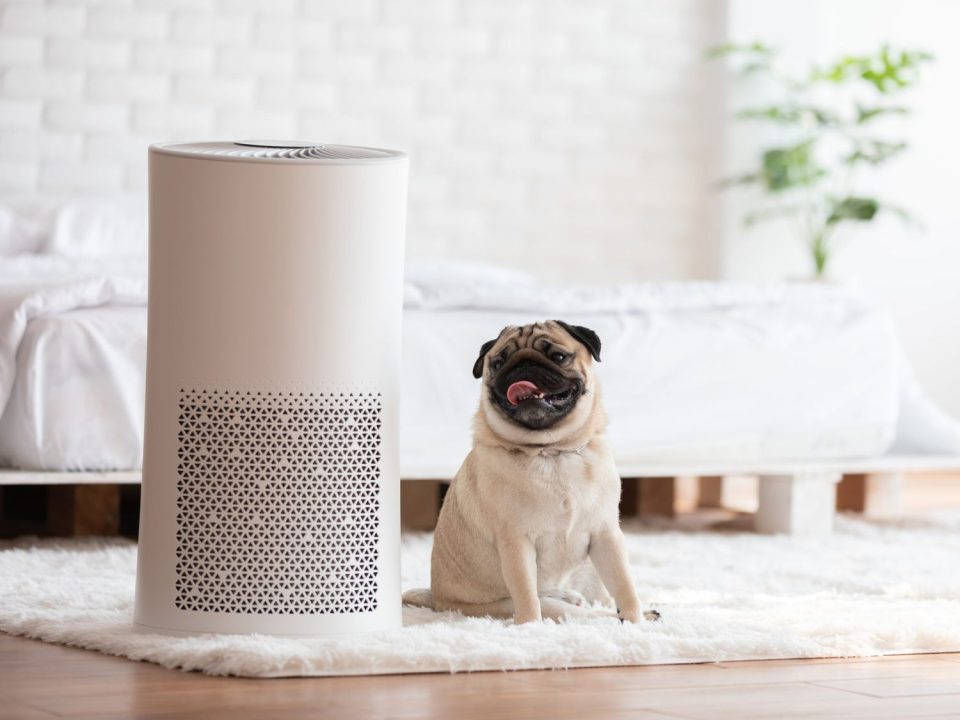
Air purifiers for when your dog makes you sick placement should prioritize the rooms where the allergic person spends the most sustained time rather than where the dog spends the most time. Bedroom placement is highest priority: sleep involves six to eight hours of sustained breathing in a single space, and reducing allergen concentration in that space during sleep reduces cumulative overnight exposure significantly.
A secondary unit in the primary living space – wherever the family spends most of its waking hours together – addresses the daily exposure that accumulates during normal household activity. The combination of bedroom and living room air purification covers the two spaces where sustained allergen exposure is highest, without requiring purification of the entire home.
The EPA Indoor Air Quality notes that pet allergens are among the most persistently problematic indoor allergens because of their light weight, aerodynamic properties, and tendency to accumulate in soft furnishings that are difficult to fully decontaminate. Air purification is most effective as a component of a comprehensive allergen reduction strategy rather than as a standalone intervention.
Continuous Operation and the Case Against Intermittent Use
Pet dander re-accumulates in room air within minutes of the source – the dog – being present and moving in the space. A unit that runs for an hour and then turns off allows dander to rebuild during the off period. Continuous low-speed operation maintains a lower steady-state concentration throughout the day by capturing dander as it is shed rather than allowing accumulation between operating cycles.
The electricity cost of continuous low-speed operation is modest – typically $20 to $40 annually for a standard residential unit – and is the operational approach that produces the most consistent air quality benefit for pet allergy management. This is more cost-effective than running the unit at high speed intermittently, which uses more electricity for less consistent benefit.
Filter condition for pet allergy management needs more frequent monitoring than the standard quarterly check. Pet dander accumulates on HEPA filters faster than general household dust, and a filter reaching saturation ahead of the recommended replacement interval loses capture efficiency before the schedule indicates it should be changed. Visual inspection monthly and replacement when saturation is visible rather than on a fixed schedule is the approach that maintains performance.
